Nanoprioritypeaks
The Core of the NanoPriority™ System: PEAKS™
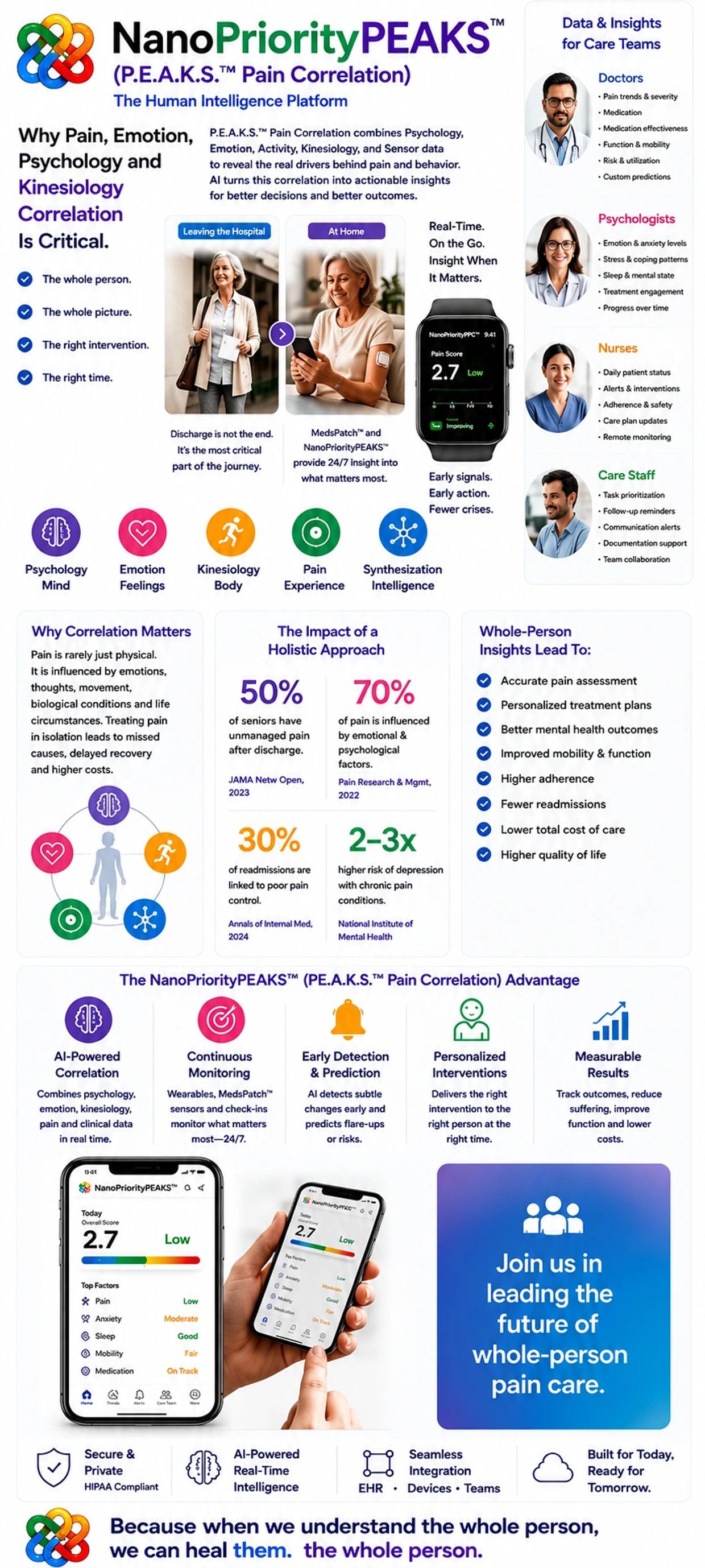
At the center of our platform is NanoPriorityPEAKS™ and PEAKS Pain™—a whole-person intelligence approach built around the correlation of Psychology, Empathy, Anxiety, Kinesiology and Synthesization.
Healthcare signals rarely exist in isolation. Pain can affect emotion; anxiety can amplify the perception of pain; medication and adherence can influence symptoms; and changes in movement, mobility, sleep, behavior and physiological signals can provide additional context.
.
The Core of the NanoPriority™ System: PEAKS™
At the center of our platform is NanoPriorityPEAKS™ and PEAKS Pain™—a whole-person intelligence approach built around the correlation of Psychology, Empathy, Anxiety, Kinesiology and Synthesization.
Healthcare signals rarely exist in isolation. Pain can affect emotion; anxiety can amplify the perception of pain; medication and adherence can influence symptoms; and changes in movement, mobility, sleep, behavior and physiological signals can provide additional context. PEAKS brings these signals together rather than evaluating each one separately.
The NanoPriority™ engine synthesizes these relationships with available clinical, medication, wearable and patient-reported information to help identify what is changing, how factors may be related, who may need attention first, and when intervention may be appropriate—without assuming that correlation itself proves causation.
PEAKS Pain™ applies this intelligence specifically to pain, helping care teams understand not simply “How much does it hurt?” but “What may be happening around the pain—and what has changed?”
The result is a more complete picture of the individual: mind, emotion, movement, medication, physiology and experience working together—supporting more personalized care, earlier attention and meaningful emotional support.
%20(1).png/:/rs=w:1240,cg:true,m)
.
.png/:/rs=w:1240,cg:true,m)
.
Why N.A.N.O. priority is The next-generation “Windows of Healthcare”
The N.A.N.O. Letters Meaning
N
Navigable-Living Moments
"Navigable-Living Moments" refers to turning highly complex, high-friction, or emotionally overwhelming stages of a patient's journey into clear, prioritize manageable steps based on this moment-in-time. To avoid overload of alerts based on ambient design to eliminate the current communications problem wheree every call or message is treated as if “The house is on fire” so pick up the phone call or view the message this moment! Ambient changes how important inforation rise to the top of the stack and unimportant information is pushed down.
A
Anatomy-Windowed
"Anatomy-windowed" refers to the process of "windowing" in medical imaging (like CT or MRI scans). It means adjusting the grayscale of a digital scan so that specific types of anatomy (e.g., bones, soft tissues, or lungs) are highlighted and clearly visible to the eye. Organizes a prioritized window into the disease, medication effects, symptoms, pain, and risk around the patient’s body and affected systems. Nano's moment-in-time color-based prioritization with ambient-enhancd visual system provides quick-view reports to help aid doctors, staff and patients.
N
Networked-Connected
Connects prioritized hospital, pharmacy, home, wearable, caregiver, and patient-reported data, rather than leaving them in separate silos. Healthcare data connection is critical during discharge because it eliminates dangerous "information silos" that disrupt patient recovery. Seamless data exchange ensures continuity of care, prevents medication errors, and reduces the risk of unnecessary, costly hospital readmissions.
Why Connected Data is Critical at Discharge?
- Medication Safety & Efficiency: NanoPriorityRx provides Pharmacy Technicians with workoad priority discharge lists with MedsPocuh priority workload lists correlated to create an efficent time-saving tool to allow the staff to spend more time on personalized care innstead of repetative tasks.
- Reconciling Medications is one of the highest-risk processes during a care transition. Connected data allows primary care doctors and pharmacies to instantly see hospital prescriptions, averting dangerous drug interactions or skipped dosages. MedsPouch was designed to emower patients remotely at home or a care facilitiy to stay in compliance and reduce frustration and typical struggles with medication adherence.
- Preventing Readmissions: Patients who leave hospitals confused about their care plans are significantly more likely to return within 30 days. Connected health records allow home health providers, specialists, and visiting nurses to access a single, up-to-date care plan.
- Eliminating Duplicate Testing: Without data sharing, outpatient providers may reorder expensive, time-consuming bloodwork or imaging already completed in the hospital.
- Empowering the Patient: Interoperability feeds into patient portals, giving individuals and their caregivers direct access to their own discharge instructions, upcoming appointments, and health summaries. Having NanoPriority;s CareCheck Software System with specific approved CareChers Staff helps empower patients and assist staff to minimze over notifications and continous data updates with visual priorized reports.
O
Outcome-Driven
Prioritizes actions linked to adherence, safety, recovery, readmission prevention, patient experience, and operational performance, A special part is understanding P.E.A.K.S. to avoid catastrophizing. Catastrophizing in healthcare is a cognitive distortion where patients or providers assume the absolute worst-case scenario regarding a health condition, treatment, or symptom. It often involves intense rumination, magnification of symptoms, and feelings of helplessness, which can significantly amplify physical suffering and delay recovery.
The Problem: Healthcare Without a Unified Visual Window
· Fragmented data: medications, diagnoses, labs, sensors, symptoms, and patient-reported information often live in different systems.
· Text-heavy interfaces: clinicians must interpret long notes, lists, and tabs before recognizing the patient’s most urgent issue.
· Alert overload: systems can generate large numbers of notifications without consistently distinguishing urgency, context, or the next best action.
· Limited emotional and pain context: conventional dashboards may underrepresent how the patient feels, functions, communicates, or expresses distress.
· Hospital-to-home discontinuity: after discharge, visibility may decline just when medication confusion, symptom escalation, caregiver strain, and missed follow-up can become consequential.
NanoHealthAI’s central thesis: Healthcare needs a new visual window that organizes the patient’s clinical and human story into one understandable, prioritized, continuously updated view.
NanoHealthAI System
A. Nano AI Twin™: Anatomy-Based Disease and Health Visualization
· Displays affected anatomy and disease burden using intuitive color, location, severity, and trend indicators.
· Links medication regimens and adherence data to the organs, systems, symptoms, and risks they are intended to influence.
· Combines longitudinal history with current data so clinicians and patients can see change over time rather than a single isolated measurement.
· Supports patient understanding by translating complex clinical information into a body-centered visual narrative.
B. NanoPriority™: From Data to Action
· Scores and ranks patients according to risk, adherence, deterioration patterns, clinical history, sensor information, and care-transition needs.
· Creates role-specific worklists for pharmacy technicians, nurses, discharge coordinators, care managers, and other authorized users.
· Uses visual priority levels and recommended next actions to reduce searching and focus attention on mission-critical events.
· Should retain clinician oversight, explainable factors, and clear escalation rules rather than functioning as an autonomous clinical decision-maker.
C. PEAKS: Emotion, Pain, and Human Context
PEAKS can be positioned as a multimodal layer that correlates: pain location and intensity, facial or vocal expression, patient-reported symptoms, anxiety or emotional state, behavioral patterns, medication timing, vital signs, and recent procedures or diagnoses.
· Helps identify patients whose pain or emotional distress may be difficult to express through standard numeric scales alone.
· Adds psychosocial context to physical disease data, supporting more personalized follow-up and communication.
· May be particularly useful for pediatrics, older adults, behavioral health, neurodiverse patients, postoperative recovery, and patients with communication challenges—subject to careful validation for each population.
D. Hospital-to-Home Connectivity
· Connects discharge plans, medication readiness, MedsPouch™ organization, adherence checks, remote monitoring, caregiver updates, and care-team follow-up.
· Maintains visibility beyond discharge through patient-reported data, devices, reminders, and structured CareCHECK™ workflows.
· Uses NanoPriority™ to distinguish routine progress from emerging risk and route the information to the appropriate team member.
%20(1).png/:/rs=w:1240,cg:true,m)
.
.png/:/rs=w:1240,cg:true,m)
Nano Group, PBC, Inc.
Copyright © 2026 Nano Group,PBC - All Rights Reserved.
This website uses cookies.
We use cookies to analyze website traffic and optimize your website experience. By accepting our use of cookies, your data will be aggregated with all other user data.